
Mailchimp
is a marketing platform, primarily known for email marketing services, which helps small businesses
manage and connect with their audience through various channels.
📆 What & when:
In this case study from May 2018 until May of 2019, I highlight how I guided the transformation of Mailchimp into building out a small business CRM, zero to one.
🙋🏼♀️ Who:
For this effort, I was acting as purely a Design Manager; guiding and supporting the 6 designers on my team, along with their cross functional peers. I was a conduit between the day-to-day work being done and Mailchimp’s executive leadership creating organizational strategy. I collaborated with other managers, directors, and cross-functional peers on a daily basis to clear the way so that the most impactful work could be delivered.
🛠 What:
The tools I used to align and communicate with the team were Figma, Dovetail, physical white boards, paper, pens, and sharpies.
Opportunity overview
☹️
Customer problem
Small business owners (Mailchimp’s original target audience) don’t have time or extra cash to learn targeted marketing best practices, but yet they need those skills to build their business.
📉
Business opportunity
Mailchimp had a ton of
customer data (and data on their customer’s customers too), but didn’t know how best to utilize it.
⭕️
Challenges to success
We had a very short timeline: only three months to ship an MVP of this high value small
business Customer Relationship Management platform.
🙈
Potential risks to success
We knew Mailchimp
customers would find the
data we had insightful but
it was a big risk to know if
they would to take action
on the insights. (Send a
campaign, social post, etc)
The “Audience Domain”

✅ We set goals & KPIs
20 million customers
Woah, that’s a lot of users of our platform…
but less than 2 million are paying
So many people utilizing the “freemium” option on the platform!
5% conversion rate increase
We’d measure our success in showing the value of our small-biz CRM and getting customers to convert to paid subscriptions.
Discovery of the MVP CRM
With no time to loose, we fast-tracked our process:
- 🔎 STEP ONE:
- Straight away, we needed to deepen our current understanding of what small business owners uniquely needed from a CRM. We went to Raleigh, South Carolina to conduct research with 32 various small business owners operated from. We sat with them, saw their spaces, and talked to them about their challenges, needs, and goals for their businesses.
- 🍱 STEP TWO:
- We returned home, synthesized the results of our research, and prioritized customer needs based on their impact to Mailchimp and data availability. As a manager, I stepped into the role of facilitator: helping lead the team through feature ambiguity, complexity around how we’d differentiate our CRM MVP offering, and prioritization of “table stakes” required features.
- ✍🏽 STEP THREE:
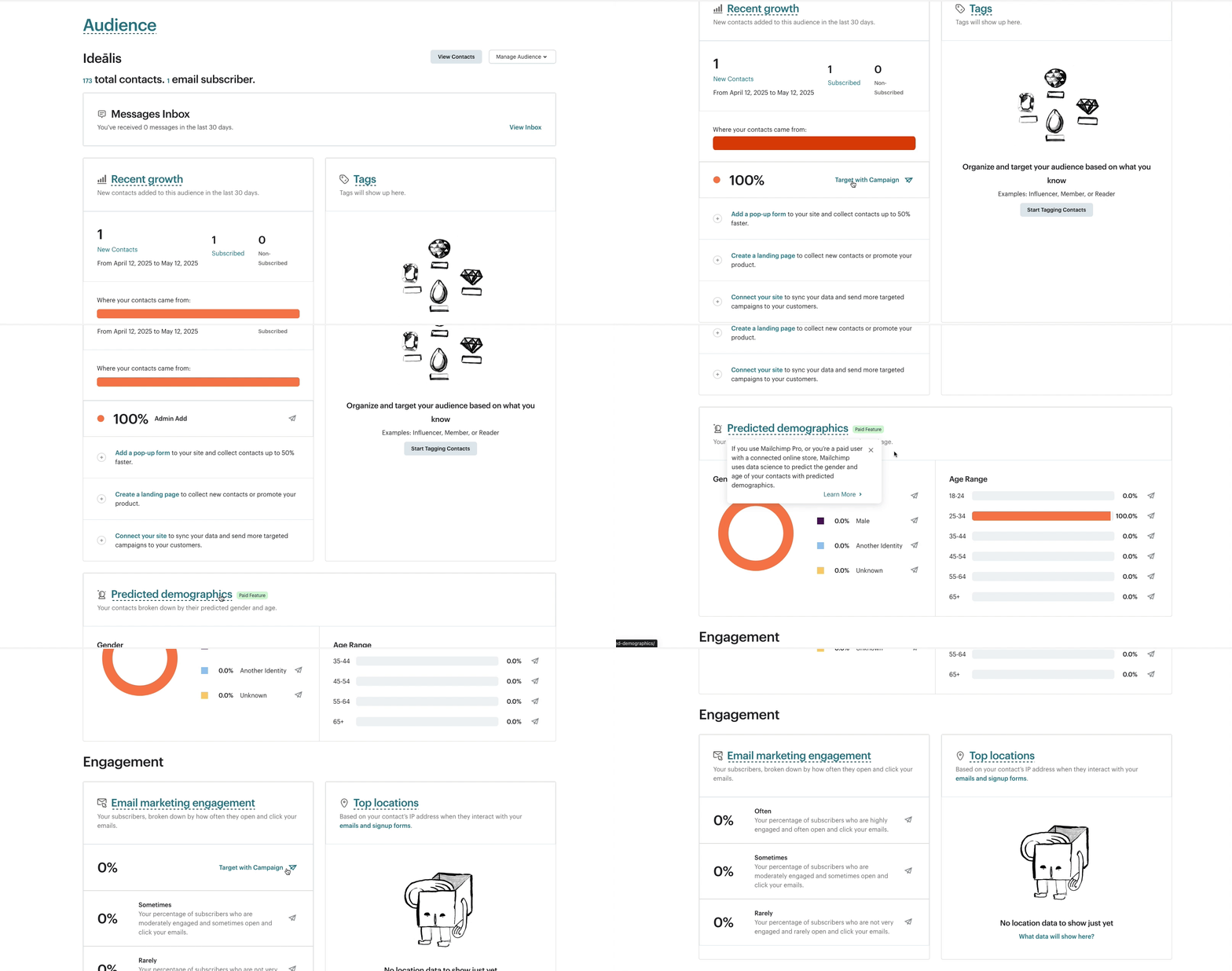
- We created our MVP hypothesis and began to test it with customers. The existing audience dashboard lacked the ability to take action on any insights (which were few). So our team explored various options and types of data we believed would help target their audience easily & effectively.
A Selection of Screens from the MVP:


Design strategy & team guidance
Establishing design principles for the Audience Overview Domain, and more…
🏔 Guidance
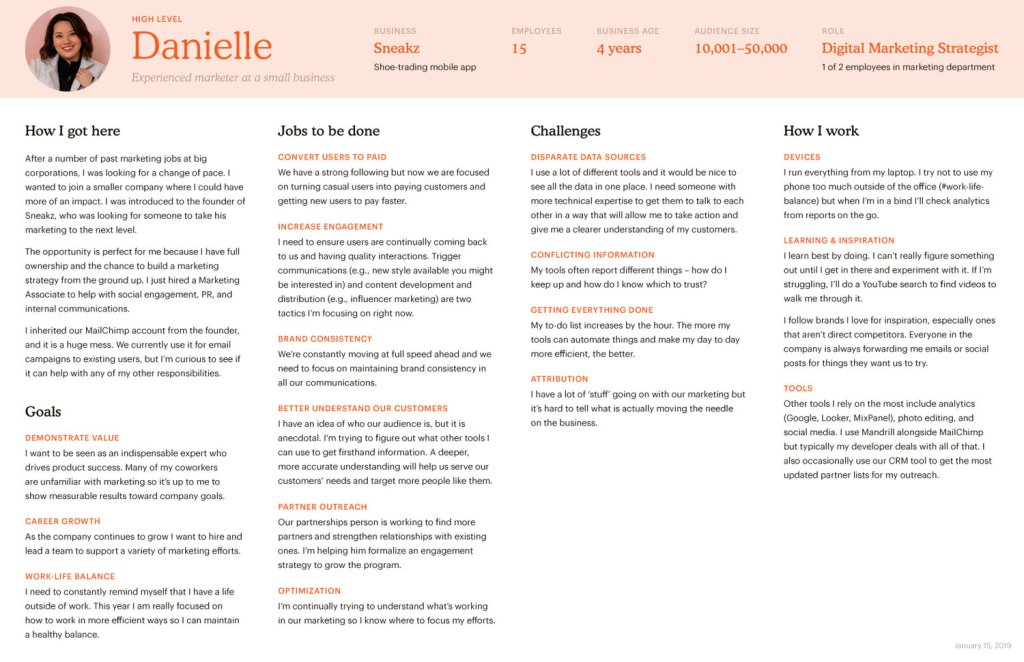
Does the CRM provide appropriate direction and education on their audiences with relevant marketing opportunities so that they feel confident in how to grow their businesses successfully? In today’s competitive marketplace, businesses must understand their target demographics and be equipped with the right tools and knowledge to leverage marketing strategies effectively. This combination of marketing insights and ongoing support enhances client confidence, enabling them to make strategic moves that align with their business goals.
🏃🏽♀️ Actionable
Do Danielle & Ethan’s experiences within their new CRM inspire initiative? As they navigate the vast features and tools available to them, do they truly trust the data Mailchimp is providing to be accurate and reflective of their actual performance? By exploring their journey with this digital platform, we can better understand how the insights and metrics impact their decision-making processes, leading them to innovate and improve their strategies moving forward.

🤲🏽 Human
Is the CRM accessible, simple, and intuitive enough for Ethan to feel confident in his actions, allowing him to navigate through its features with ease and clarity? It is crucial that the platform strikes a balance between user-friendliness for beginners, like Ethan, and the robust functionalities needed by experienced users, like Danielle, ensuring that both employees can optimize their productivity and workflow seamlessly.
👟 Progressive detail
Does the CRM provide Ethan & Danielle only what they are requiring at the moment it’s needed, and nothing more? By ensuring that the system filters and delivers only the relevant data, Ethan and Danielle can maintain their focus, avoid unnecessary distractions, and optimize their productivity, all while relying on a streamlined tool that supports their goals without overwhelming them with extraneous information.
We iterated and worked together as a team to apply changes quickly
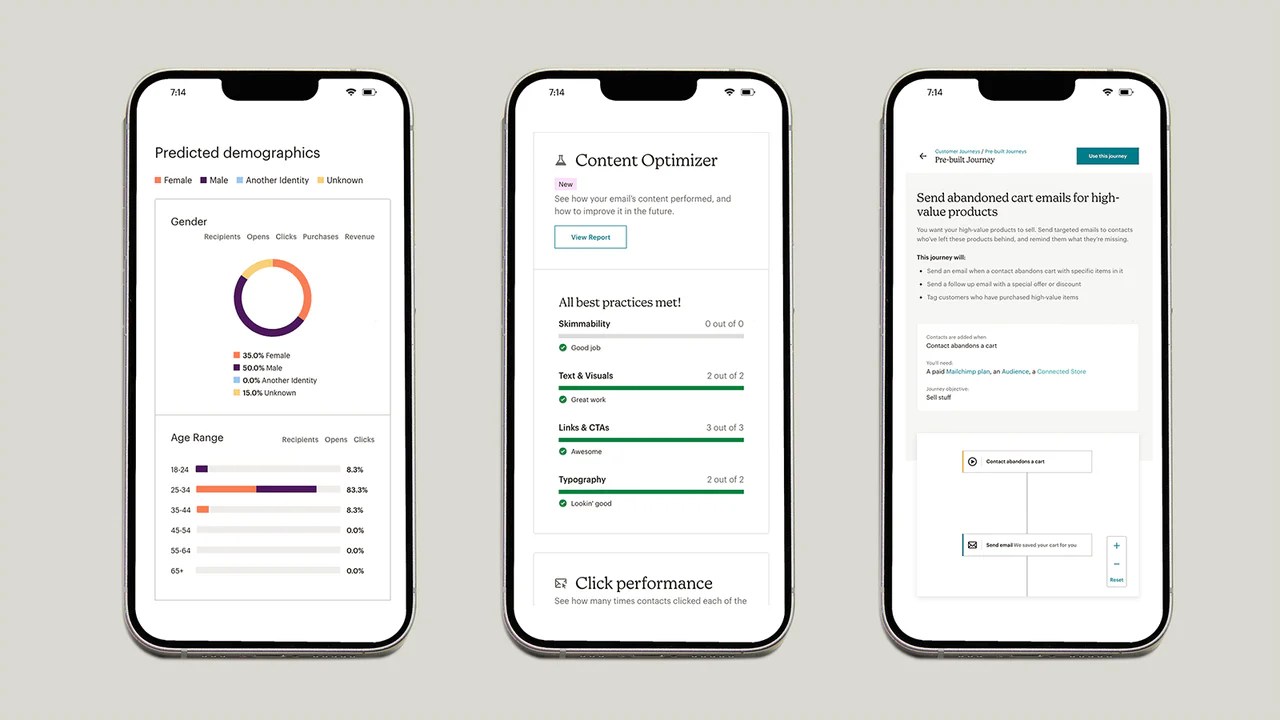
Customers expressed delight at the first offering that gave them a deeper understanding of their customer base, at just a glance. With just the MVP launch, they saw data they’d never known about their audience and started to use it to better target their products.
“Mailchimp serves as a robust tool for executing targeted campaigns directed at both teachers and administrators. The scope of our use case extends beyond mere communication to actively harnessing data-driven insights for optimizing our engagement strategies.”
Joshua Rodriguez, Digital Marketing Strategist
Hāpara (e-Learning, 11-50 employees)
“For small businesses like mine, Mailchimp is the most affordable marketing automation tool available – perfect for startups. This is an essential tool to create and manage mailing lists and newsletters, as well as automate email campaigns and collect leads. After implementing this my business performance has increased rapidly.”
Hemanta Sahu, Digital Marketing Specialist
Ameex Technologies (IT services, 501-1000 employees)
Notable customers impacted

Jittery Joe’s Coffee
(Athens, GA)

Earl of East
(London, United Kingdom)

Six Barrel Soda
(Hawke’s Bay, New Zealand)
Resulting business & customer impact
141%
Increase in small business customers’s revenue
11 MIL
Global customers impacted
6.6%
Conversion rate, freemium to paid 🎉
Takeaways & learnings
It’s my philosophy that every project and experience has something to teach us. No matter the expertise or experience of the person, there is always something to learn and take away from a project that could be done better or differently next time. There’s also always things done well that should be done and re-applied for the next project as well! Here’s a few of those reflections on the Mailchimp small-business Customer Relationship Management project:
🏆 Things we did well
- Engaged engineering early for co-creation
- Tailored features for varied mobile needs
- Designed thoughtful empty states from the start
- Prioritized visualizations using research insights
- Focused on actionable data from quick surveys
- Partnered closely with Data Scientists
- Rapidly tested CTA UX via A/B/C experiments
- Launched on time with immediate business impact

🧐 Things we could have done better
- Involve marketing earlier in the process
- Add more early moments of delight
- Bring in senior design support sooner
- Track UX metrics and analytics more closely
- Increase hands-on pairing with design team
 Idealis Design