
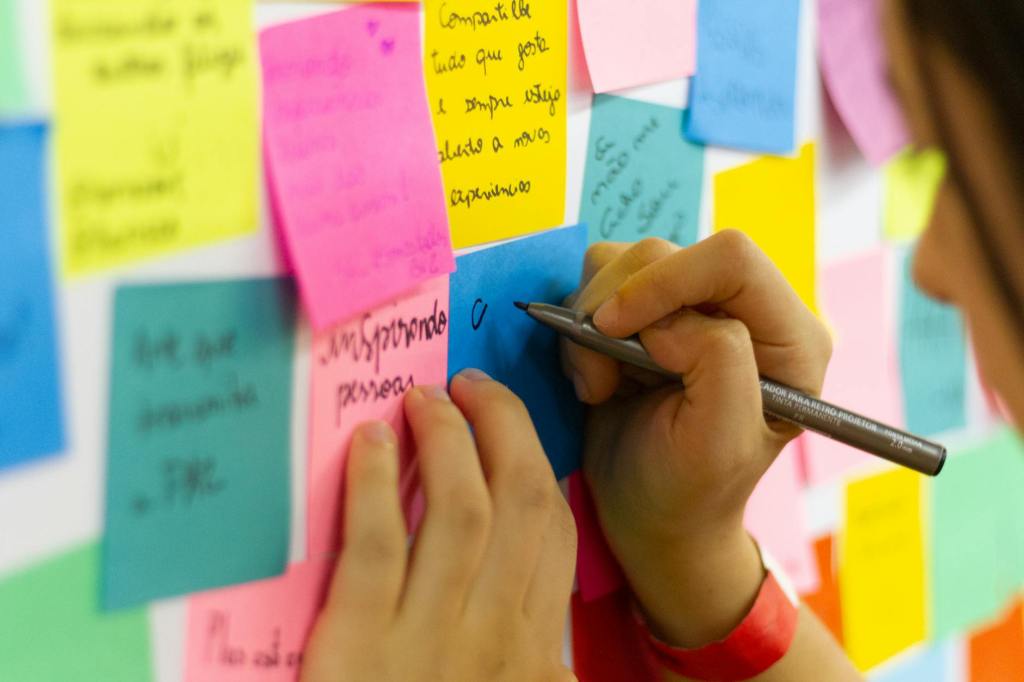
How I can lead a group of people from Point A to Point B, together, and get them to all align around a decision?
I specialize in bringing a technique called “catalyst meeting facilitation” to all my clients and teams. These are sessions which can bring people together to bring focus to a topic, and make key decisions together, faster. A catalyst meeting brings a group from Point A (current state) to Point B (desired state) as an intentional outcome, whether a team is remote or in-person. Examples include but are not limited to:
- Strategic planning
- Working sessions / workshops
- Product reviews
- Generating product ideas for experimentation and innovation
The main objective when I am running Catalyst meeting is to create/update a plan, generate ideas, solve problems, or leading the group into aligning around a decision.
Bringing a group of diverse thinkers together to gain shared understanding, generate new innovative ideas, and or drive to a collective decision is the precipice to innovation. This is no small or easy task. It takes forethought or pre-planning, facilitation skills that you’ll hone over time (which we’ll practice shortly today), and of course, everyone’s favorite, a little vulnerability.
Catalyst meeting facilitation
I help anyone learn to run a productive “meeting” where everyone leaves having their voice heard, and feeling more productive than they have been in the past.
What does it mean to be a catalyst meeting facilitator?
Anyone, and I mean anyone, can run a meeting in this manner. It doesn’t matter if you’re an engineer – you can facilitate a feature prioritization conversation. It doesn’t matter if you’re a product person – you can guide and facilitate a productive technical infrastructure decision. These catalyst meetings help us meet in the overlap space between our roles. As facilitators, we need to be as neutral as possible and guide the group toward the outcome decided on prior to the start of the session. This does not mean that you are the decision maker and the loudest voice in the room. Oftentimes, that’s the opposite of true. Your job as facilitator is to get out of the way of the group and help land the plane in the new desired location. Rather than leading, it’s almost better to look at it as shepherding.
Why do I utilize these techniques for in-person and remote teams?
Catalyst meetings are a type of meeting structure that introduces an infinite number of techniques to support collective, inclusive decision making. When you first start hosting this type of meeting, you may want to start small or start with one that’s familiar to you already. Retros can be a great place to start. As product people we’ve all been in retros, but oftentimes the baton of being facilitator does not get passed so that others can practice flexing the muscle of facilitation. It’s good for a team to have shared responsibilities and good for the individuals in practicing their facilitation skills. That way, over time, you start to host harder and harder conversations. You may eventually even start to make up your own frameworks.
When do I use my facilitation techniques in meetings?
Anytime you notice friction or misalignment amongst a group of people (large or small). This can also look like people with two very different perspectives just talking past each other, or running into some friction around a decision, or spinning in circles about how to think about or name a thing. Some tension on teams is natural, and actually necessary. When everyone is agreeing and there’s total 100% consensus on something, it’s stinky. It smells of someone not speaking up or sharing their perspective. Rather, it’s best to strive for alignment. The facilitator becomes the conductor of the orchestra. It’s an other-centered way of being in that moment, rather than self-centered and there’s a beautiful tension between instruments in every great song.
The Do’s & Do not’s of catalyst meetings:
Here is a list of my most basic facilitation approaches for leading large groups from one point to another and getting them to align on decisions.
Don’t
- Don’t be afraid of silence. Start counting down from 10 or 20 in your head, if you get the urge to fill space. Giving space for folks to think feels awkward but is a catalyst to even stronger innovation in the end.
- Don’t interrupt people unless the discussion is being derailed. There are separate techniques for pulling from quiet folks and taking microphones away from those who’ve self-appointed as MC of the group.
- Don’t insert your own thoughts or opinions. You are the personification of Switzerland: stay neutral!
- Don’t put individuals on the spot, unless you know for sure they won’t mind it in a group setting.
- Don’t lose track of time. Develop a sense of how long each task or question will take and keep things moving in the direction you need. Get a co-facilitator to watch the clock if you need it.
Do
- Pause often. Count to 10 or 20, slowly, in your head. Allow space for others to fill silence, openly reflect, or just quietly think.
- Be the best listener you can be. Active listening is a muscle anyone can develop.
- Pull from the quiet ones. Often they’re so full of thoughts that need to be prompted or pulled from a bit.
- Mirror back what you heard. Play it back to the person or to the group and see if you get any nuance, correction, or even just nodding of the heads.
- Check for group learning. Did they reach their target “Point B” that everyone had aligned on in the beginning?
- Ask great questions to propel the discussion, even if you think you know the answer.
- Name the elephant in the room, if there is one. Sometimes a group will not get un-stuck until the ‘hard thing’ is openly named and discussed.
“Thank you, thank you! That was an amazing workshop!”
– Senior Program Manager, Revenue Operations @ Aurora Solar
 Idealis Design